
The High Latitude Time Domain Survey (HLTDS) is one of the three CCS that Roman will carry out during its nominal 5-year mission. The primary goal of the HLTDS is to use Type Ia supernovae (SNe Ia) as cosmological probes to measure the expansion history of the Universe. The light curves of SNe Ia are powerful "standardizable" candles: measurement of their peak luminosity, evolution time scale, and color can be used to infer reliable distances to these sources. As a result, SNe Ia offered the first evidence of the accelerating expansion of the Universe, commonly attributed to dark energy. With its large field-of-view, exceptional sensitivity, and near-infrared (NIR) band pass, Roman will be by far the most efficient discovery machine of SNe Ia at redshifts z > 1. Furthermore, the NIR transient sky has been less well explored to date, offering the opportunity for serendipitous discovery. The in-guide survey, recommended by the ROTAC, consists of a core component, a pilot component, and an extended component, with both wide-field imaging and prism spectroscopy. The in-guide survey should result in ~31.1 SNe Ia with z<2.0 within ±10 rest-frame days of maximum light per Roman pointing, for a total of ~25000 with z<2.0 (with 2 detections minimum at signal-to-noise ratio SNR>5). When combined with other complementary cosmological probes (e.g., weak lensing, baryon acoustic oscillations), the HLTDS requirement is to achieve a Dark Energy Task Force (Albrecht et al. 2006; Wang 2008) Figure of Merit > 325.
| Tier |
Pointings
[North: South] |
Area (deg2)
[North: South] |
Pilot Component Time (days) [North: South] |
Core Component Time (days) [North: South] |
Extended Component Time (days) [North: South] |
|---|---|---|---|---|---|
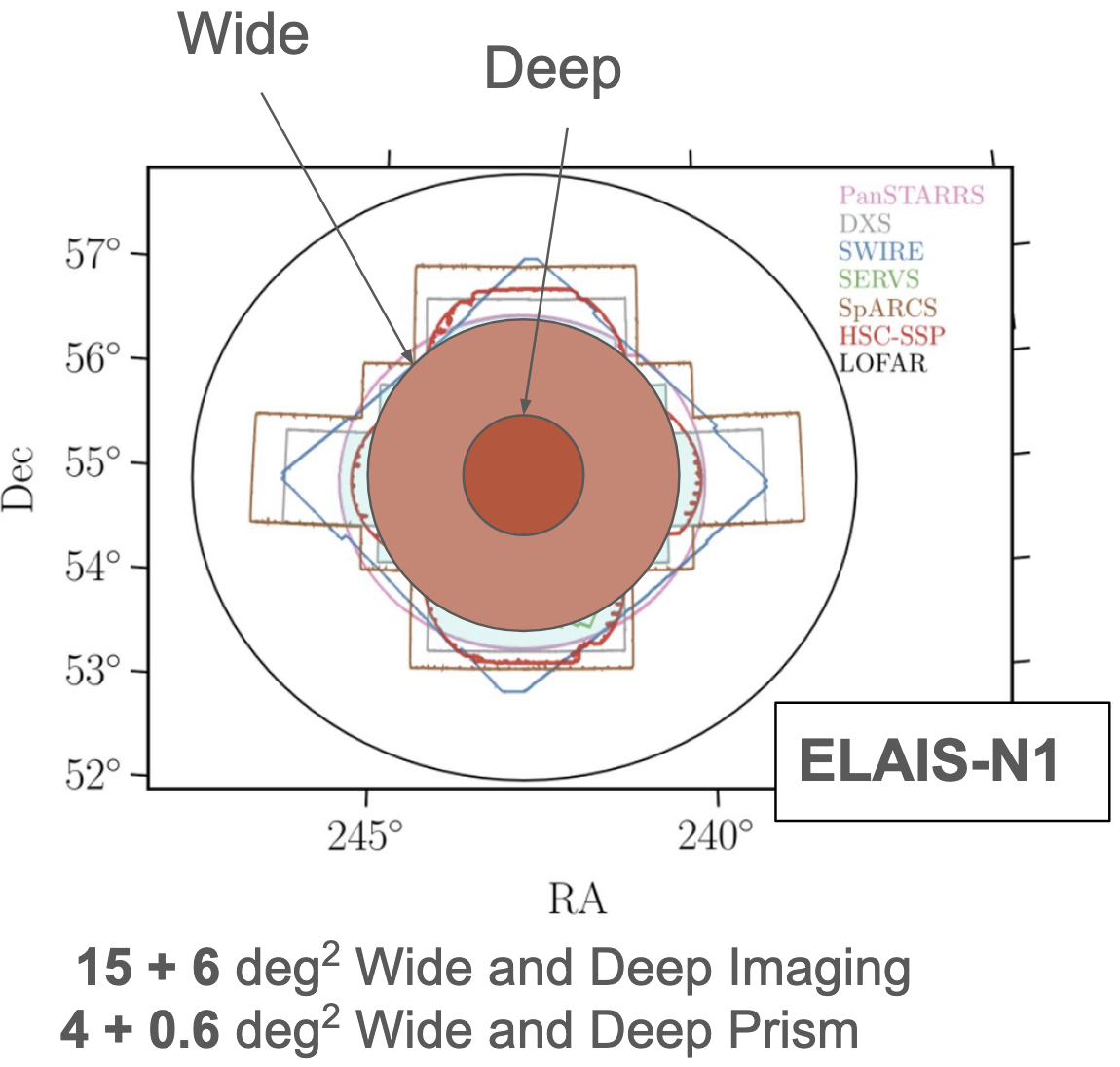
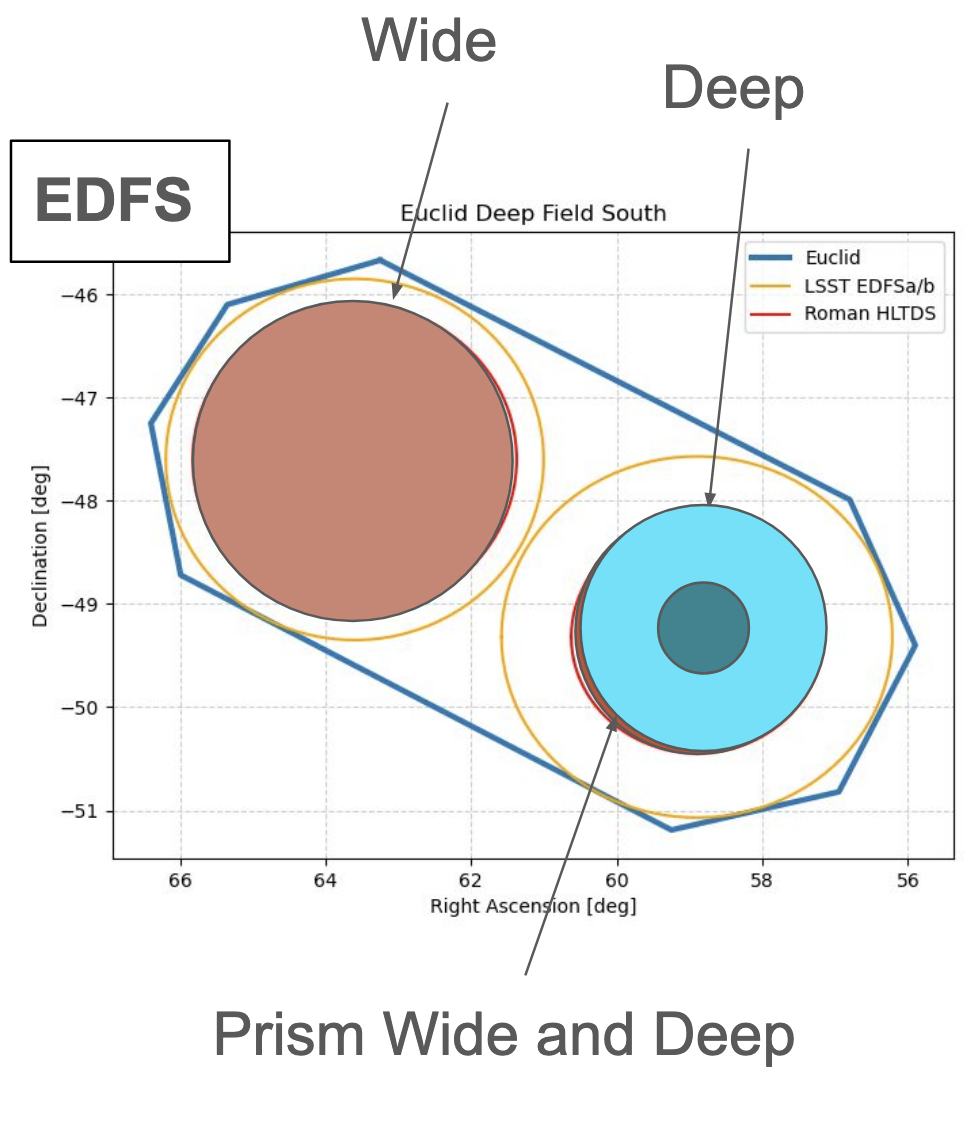
| Wide Imaging | 38 : 27 | 10.68: 7.59 | 3.73 : 2.58 | 33.99 : 23.53 | 0 : 0 |
| Deep Imaging | 7 : 16 | 1.97 : 4.50 | 2.17 : 4.96 | 19.79 : 45.23 | 2.17 : 4.96 |
| Wide Spectroscopy | 0 : 14 | 0 : 4.50 | 0 : 1.23 | 0 : 22.47 | 0 : 0 |
| Deep Spectroscopy | 0 : 2 | 0 : 0.56 | 0 : 0.70 | 0 : 12.86 | 0 : 0 |
| Total Time (days) | ... | ... | 15.36 | 157.84 | 7.12 |
 |
 |